Essential business documents for UK handymen in 2026
Templates and forms for UK handymans: Handyman business templates →
TL;DR: A UK handyman needs paperwork that keeps small-job scope, access, customer approval, materials, invoices and exclusions clear. The useful pack is quote, job sheet, materials record, customer approval note, invoice and limitation note. Handyman work is broad by nature: a morning repair, a flat-pack build, a landlord snag list, a gate adjustment, then a job that needs a qualified trade instead. Good documents help you look organised without pretending every task is the same size or risk. The point is not to create paperwork for its own sake. The point is to make the work easier to prove, price, repeat and hand back to the customer without relying on memory. For a handyman, the useful document pack should answer four questions quickly: what was agreed, what happened, what is owed, and what needs following up.
Why documents matter for UK handymen
For handymen, the awkward admin moments usually start around quote and scope note, job sheet and materials record. A missing detail can become a longer customer conversation, an unpaid balance, a repeated visit or a bookkeeping gap. Written records keep the practical detail close to the work instead of scattered across messages, memory and receipts. For handymen, the most useful paperwork is not a huge binder. It is a small set of repeatable forms that match the way the business actually operates. Keep the pack close to the moments where decisions are made: save job photos and customer approvals, attach materials receipts to each job, the invoice, the payment note and the follow-up. When each step has a named record, the handyman business feels calmer and customers get clearer answers.
The documents to keep ready
1. Quote and scope note
Write down the task, rooms or areas, assumptions, exclusions, materials and labour basis. A clear scope stops a small job expanding quietly.
2. Job sheet
Record the customer, address, work completed, materials used, photos taken and next action. This gives each visit a simple record.
3. Materials record
Keep receipts and notes for screws, fixings, timber, sealant, paint, hardware and customer-supplied materials. It protects margin.
4. Customer approval note
When extra work appears, get written approval for the added time or materials before doing it. Short messages count if saved properly.
5. Invoice
Show labour, materials, call-out, deposit, balance and payment terms. Landlords and business customers often need a clearer paper trail.
6. Limitation note
Record work that was outside scope, unsafe, inaccessible or better referred to a regulated trade. This protects both the customer and your boundaries.
How to use the documents without creating admin drag
Build the habit around the way the work actually happens: save job photos and customer approvals, then attach materials receipts to each job. If those two steps happen while the week is still fresh, the rest of the paperwork becomes a short tidy-up rather than a full reconstruction. When the customer record, receipts for materials and fixings and tool replacement, invoices and payment notes sit together, updating the bookkeeping record stops feeling like a separate investigation.
What to keep digital
For handymen, customer-facing documents should be easy to send and finance records should be easy to search. Keep the documents as PDFs or editable templates, keep the bookkeeping record in one spreadsheet or software system, and use file names that include the customer, date and job type. For handymen, a phone inbox is useful evidence in the moment, but it is a poor long-term filing system. Save the details that prove the booking, payment and customer instructions for quote and scope note somewhere searchable before the message thread disappears under the next week's work.
A weekly filing slot
Set aside one short slot each week and use it only for filing. Match each receipt to the job it belongs to, write the customer and the amount on the same note, and put anything unclear in a separate pile instead of guessing. Do the same for money that came in. When the slot is finished, the week's folder should tell you what was earned, what was spent, and which job each item belonged to. That habit is easier to keep than a pile of notes at the end of the year, and it gives an accountant a clean set of records to review.
Where LaunchKit fits
LaunchKit's handyman business documents pack gives you a ready-made starting point for the documents above. The handyman niche page also includes finance forms and pricing tools where they are available for this niche. This article is general guidance, not legal advice or tax advice. Review templates against your own circumstances and get professional advice where your situation needs it.
Next useful links
Build out your handyman setup
Handyman business templates
See the LaunchKit hub for handymans.
Trades & Construction templates
Compare related trades & construction business resources.
Handyman Business Documents — Premium
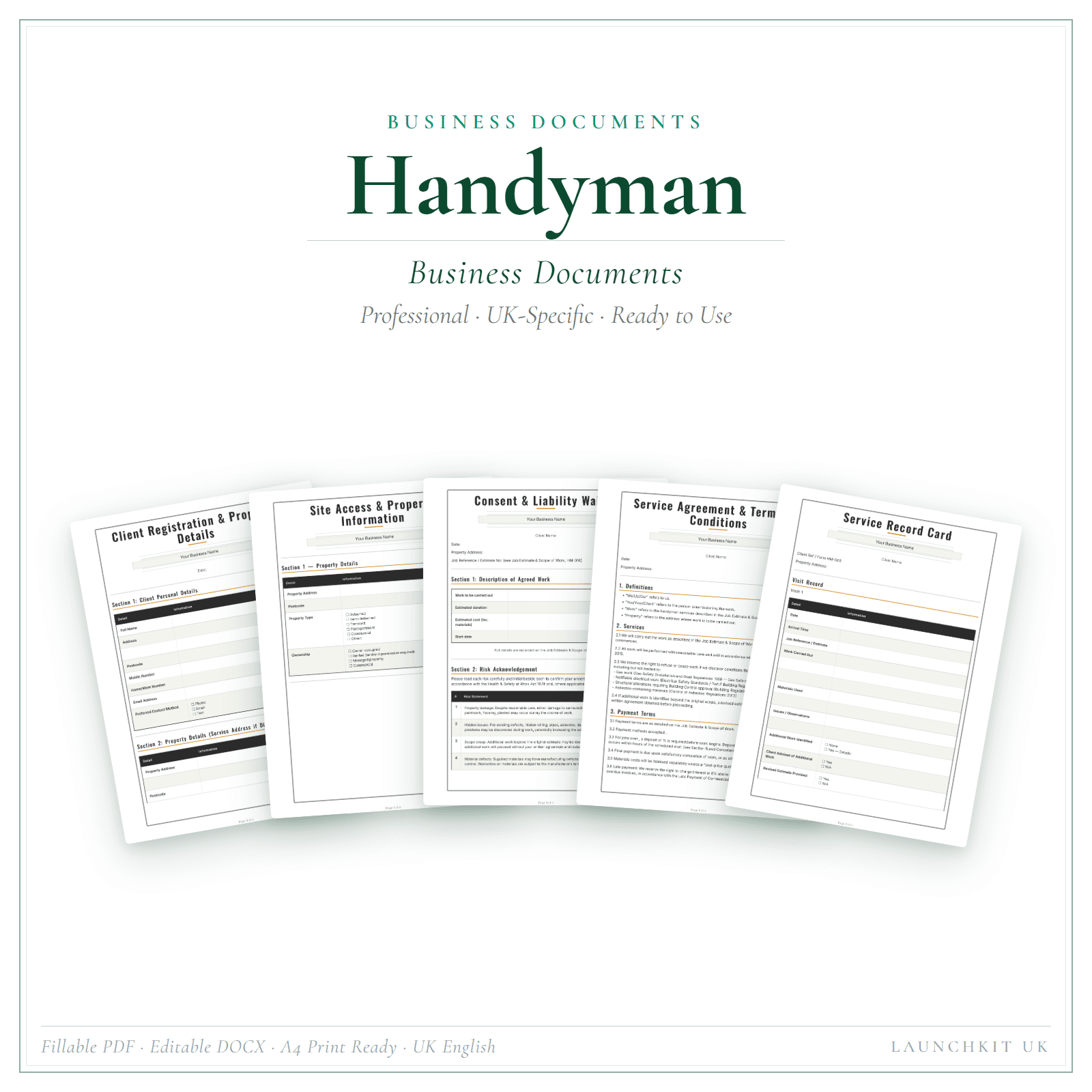
17 business-record templates for Handyman businesses, each supplied as a fillable PDF and an editable DOCX file.
How to Start a Handyman Business in the UK: A First-30-Days Order
Starting a handyman business in the UK is less about tools and more about sequence. Register with HMRC, sort public liability, and know which jobs to refer to a qualified trade. This…
How to Start a Handyman Business in the UK
To start a handyman business in the UK, set service boundaries before buying more tools, understand gas, electrical and building-control limits, insure the work you actually do, quote small jobs…
Related LaunchKit tools
Templates mentioned in this guide
More tips for handymans
Free advice, templates and product updates. No spam.