Making Tax Digital for handymen: practical checks for your records
Templates and forms for UK handymans: Handyman business templates →
In short: This is a practical guide for self-employed handymen who want their records in good shape for Making Tax Digital for Income Tax. It does not decide whether Making Tax Digital applies to you. GOV.UK has an official checker for that: find out if and when you need to use Making Tax Digital for Income Tax. Use this page to plan your records, then confirm your own position on GOV.UK or with an accountant.
First, check whether and when it applies to you
HMRC's guidance page Find out if and when you need to use Making Tax Digital for Income Tax explains who it covers and when they start. When we checked that page on 3 October 2026, it set out these start dates, based on qualifying income from self-employment and property:
- qualifying income over £50,000 in the 2024 to 2025 tax year: from 6 April 2026
- qualifying income over £30,000 in the 2025 to 2026 tax year: from 6 April 2027
- qualifying income over £20,000 in the 2026 to 2027 tax year: from 6 April 2028
Those figures come from that GOV.UK page and can change, so read the current version rather than relying on this summary. GOV.UK also explains how to work out your qualifying income and whether you may be exempt.
Practical checks to do now:
- Find your most recent Self Assessment tax return and note your self-employment income and any property income.
- Run the checker on the GOV.UK page with those figures.
- Keep any letter from HMRC about Making Tax Digital with your tax papers, and read it alongside the GOV.UK guidance.
- If you have an accountant, ask them to confirm whether and when it applies to you, and who will do what.
What to read on GOV.UK before you change anything
HMRC's step-by-step guide, Use Making Tax Digital for Income Tax, covers signing up, keeping digital records, sending quarterly updates and submitting your tax return through software. Before you choose a setup, read these sections and note what they say for your situation:
- Create digital records: which records need to be digital, and how GOV.UK describes moving information between programs (it calls these digital links).
- Send quarterly updates: what an update contains, the update periods and the dates that apply to you.
- Choose the right software: how to find software that works with Making Tax Digital for Income Tax and fits the way you keep records.
- Sign up: the steps HMRC lists for signing up, if the checker says it applies to you.
Questions worth writing down and answering from those pages, or with your accountant:
- Which of my records need to be kept digitally, and from what date?
- Which update periods and dates apply to me this tax year?
- If I keep a spreadsheet and use separate software, how will the figures move from one to the other?
- Does the software I am looking at handle my income sources, and does it work with my bank or invoicing tools?
What makes record keeping different for handymen
Every kind of business has its own record-keeping quirks. For handymen, these are the ones worth planning for:
- Materials may be bought before payment. A job can need parts before the customer pays. Record the supplier cost when it happens.
- Small jobs can pile up quickly. Many short jobs can produce more finance lines than one large project. Record them weekly.
- Landlord invoices may settle later. Property managers and landlords may pay after completion. Keep invoice date and payment date clear.
- Regulated-trade referrals affect income. Some work should be referred out. Keep notes clear so your income record matches what you actually completed.
None of these is a problem in itself. The risk is leaving them in your head until a deadline forces you to rebuild the records from bank statements and memory.
Income worth tracking separately
For a handyman, income may come from one-off jobs, repeat customers, deposits, add-ons and retained arrangements. Record each payment when it arrives and connect it back to the job, customer, booking, route or invoice that produced it. Use the quote and scope note, invoice or customer reference as the anchor for deposits, balances and late-settling income. Save receipts for materials and fixings and tool replacement as soon as they arrive, so the cost side is not waiting on customer settlement before it is recorded. If cash is still part of your business, record it in the same week. Cash is not the issue; missing records are.
How a particular kind of income should be treated for tax is a question for GOV.UK or your accountant, not for a spreadsheet layout.
Expense categories worth setting up early
A short, stable list of expense categories saves time every week. For handymen, common categories include:
- materials and fixings
- tool replacement
- van costs
- fuel
- parking
- insurance
A category on this list is a way of organising receipts, not a ruling that a cost can be claimed. Check GOV.UK's guide to expenses if you're self-employed, and its page on simplified expenses for vehicles, working from home and the current mileage rates, or ask an accountant about anything unclear.
A simple weekly routine
Small, regular admin is easier than a once-a-year catch-up. A 15 to 30 minute slot each week works for most sole traders:
- Add the week's income, matched to invoices or bookings.
- Add the week's expenses and file the receipt or photo next to the entry.
- Check the category on anything new or unusual.
- Flag anything you are unsure about instead of guessing, and keep a list for your accountant.
- Glance at your bank feed or statement to catch anything you missed.
A separate business bank account makes every one of those steps quicker, because business and personal spending stop sharing a statement. GOV.UK's page on keeping records if you're self-employed lists the kinds of records to keep.
Software, spreadsheet or accountant: choosing a setup
There are three common ways to organise this. Which one suits you depends on how many transactions you have, how comfortable you are with software and what you already pay for:
- Accounting software that keeps your records and can send information to HMRC. Check it appears in GOV.UK's software finder and supports your income sources before you pay for it.
- A spreadsheet with separate software that reads it and sends the information. Read GOV.UK's guidance on digital records first, so you know how figures are expected to move between the two.
- An accountant or bookkeeper who handles the software side for you. It still pays to keep your records up to date through the year, because they can only work with what you give them.
Prices and features change often, so compare current options rather than relying on a list in an article.
Other taxes and schemes to check separately
- VAT. VAT is a separate tax with its own registration rules. Check GOV.UK's VAT registration guidance for the current threshold and whether it applies to you.
- Construction Industry Scheme (CIS). If you work for contractors in construction, check GOV.UK's CIS guidance and keep a record of each payment and any deduction shown on your statements, so your accountant can match them up.
- Staff and payroll. If you employ anyone, payroll is a separate system with its own records. Ask your accountant or check GOV.UK.
What to do this month
- Run the GOV.UK checker and note what it says.
- Open a separate business bank account if you do not already have one.
- Set up your income and expense categories using the lists above as a starting point.
- Book a weekly admin slot in your diary and keep it.
- Decide on software, a spreadsheet route or an accountant, using GOV.UK's guidance to check the option you choose.
For the wider paperwork side of running your business, see Essential business documents for UK handymen in 2026.
If you also want ready-made templates for invoices and routine money records, LaunchKit's Handyman Financial Forms Bundle gives you fillable PDF and editable Word record templates. It is not Making Tax Digital software: it does not send anything to HMRC and is not a substitute for the software GOV.UK describes.
This article is general information to help you organise your records. It is not tax, legal or financial advice. Rules and dates can change: check current GOV.UK guidance, and ask a qualified accountant about your own position.
Next useful links
Build out your handyman setup
Handyman business templates
See the LaunchKit hub for handymans.
Trades & Construction templates
Compare related trades & construction business resources.
Handyman Financial Forms Bundle — Premium
10 distinct financial record templates for Handyman businesses, each supplied as a fillable PDF and an editable DOCX file.
Essential business documents for UK handymen in 2026
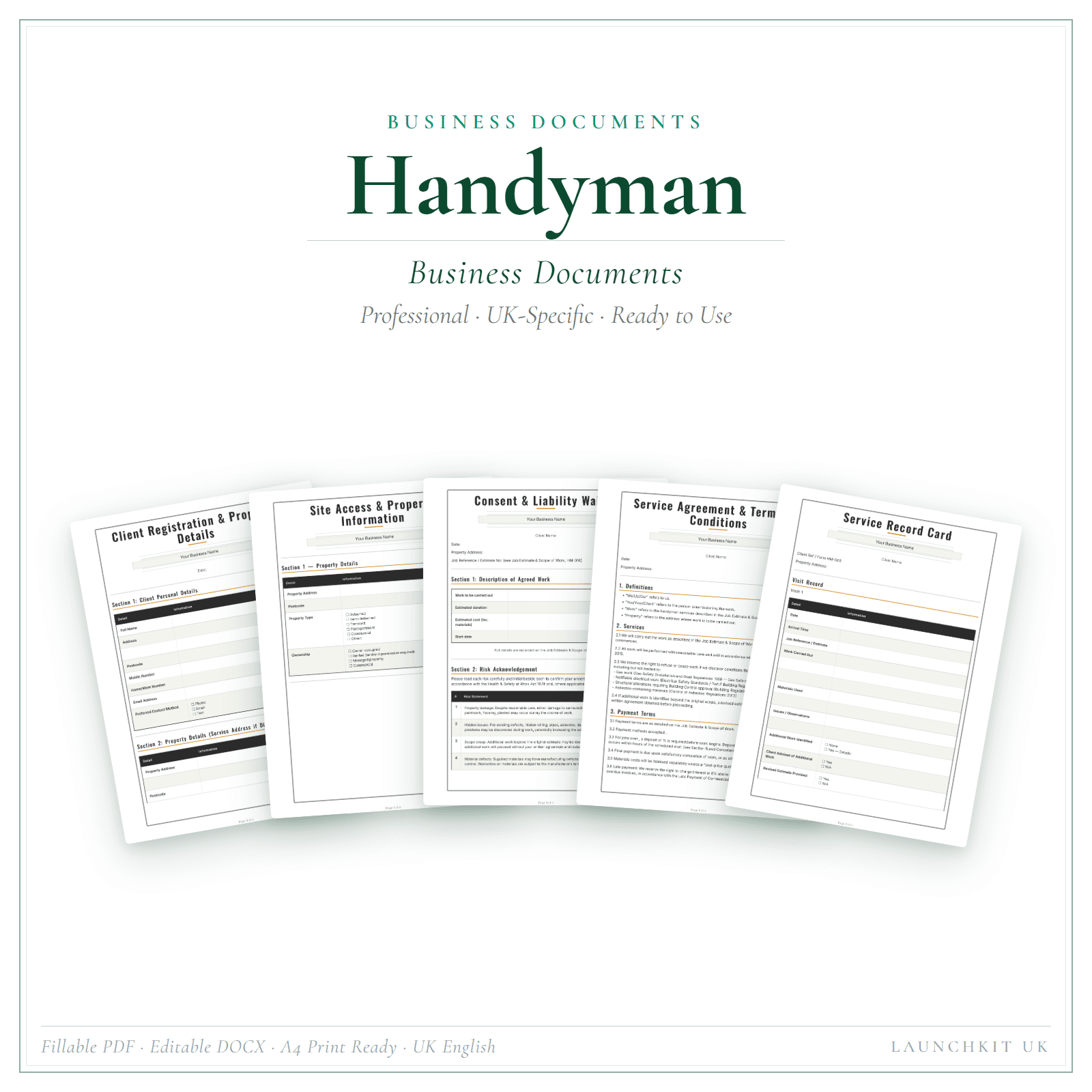
A UK handyman needs paperwork that keeps small-job scope, access, customer approval, materials, invoices and exclusions clear. The useful pack is quote, job sheet, materials record, customer approval…
How to Start a Handyman Business in the UK: A First-30-Days Order
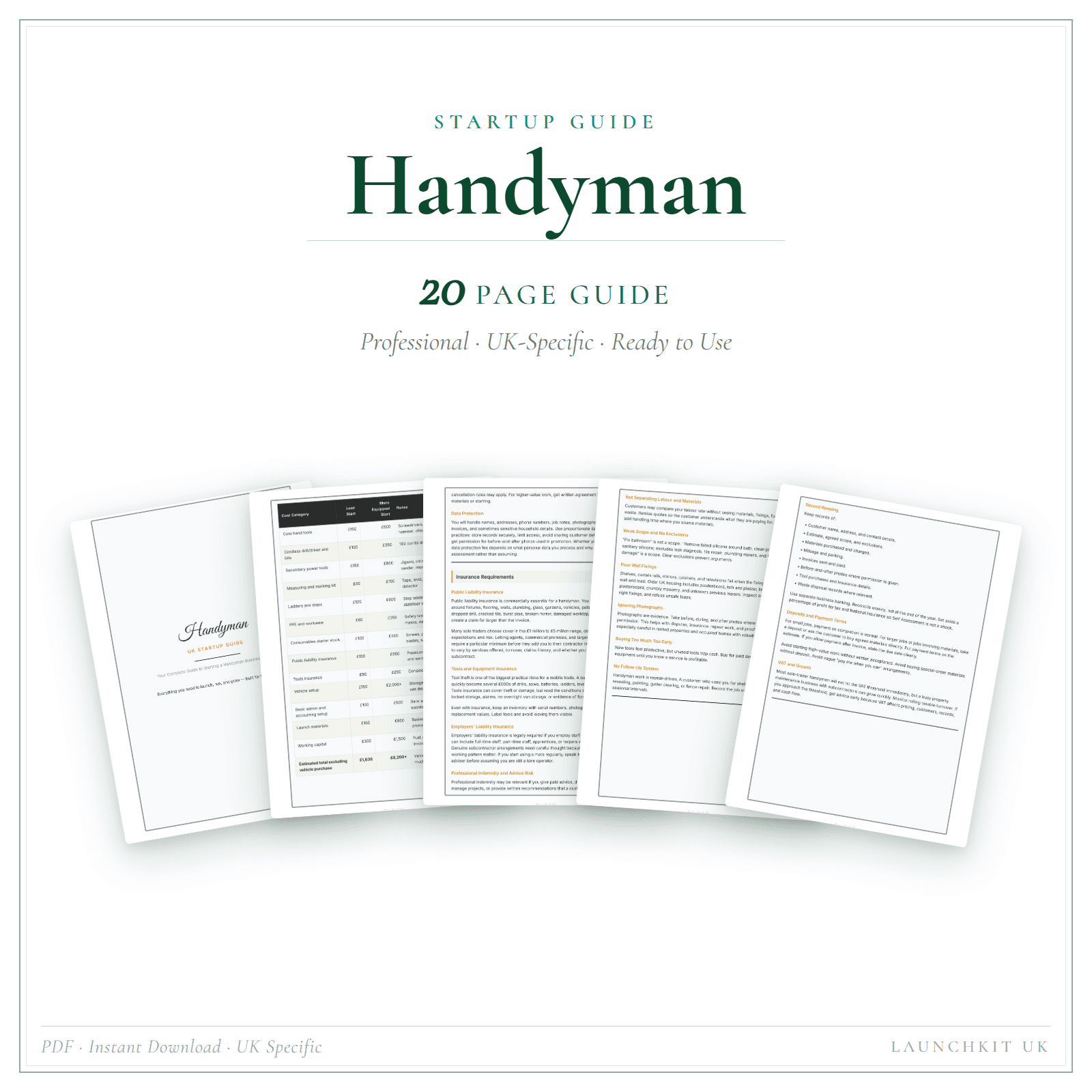
Starting a handyman business in the UK is less about tools and more about sequence. Register with HMRC, sort public liability, and know which jobs to refer to a qualified trade. This…
Related LaunchKit tools
Templates mentioned in this guide
More tips for handymans
Free advice, templates and product updates. No spam.