Plan the setup tasks you still need to complete.
Bricklayer
Bricklayer Startup Guide
Digital downloadPrint-ready PDFInstant access
1 / 4
Real-world example
Look inside before you buy.
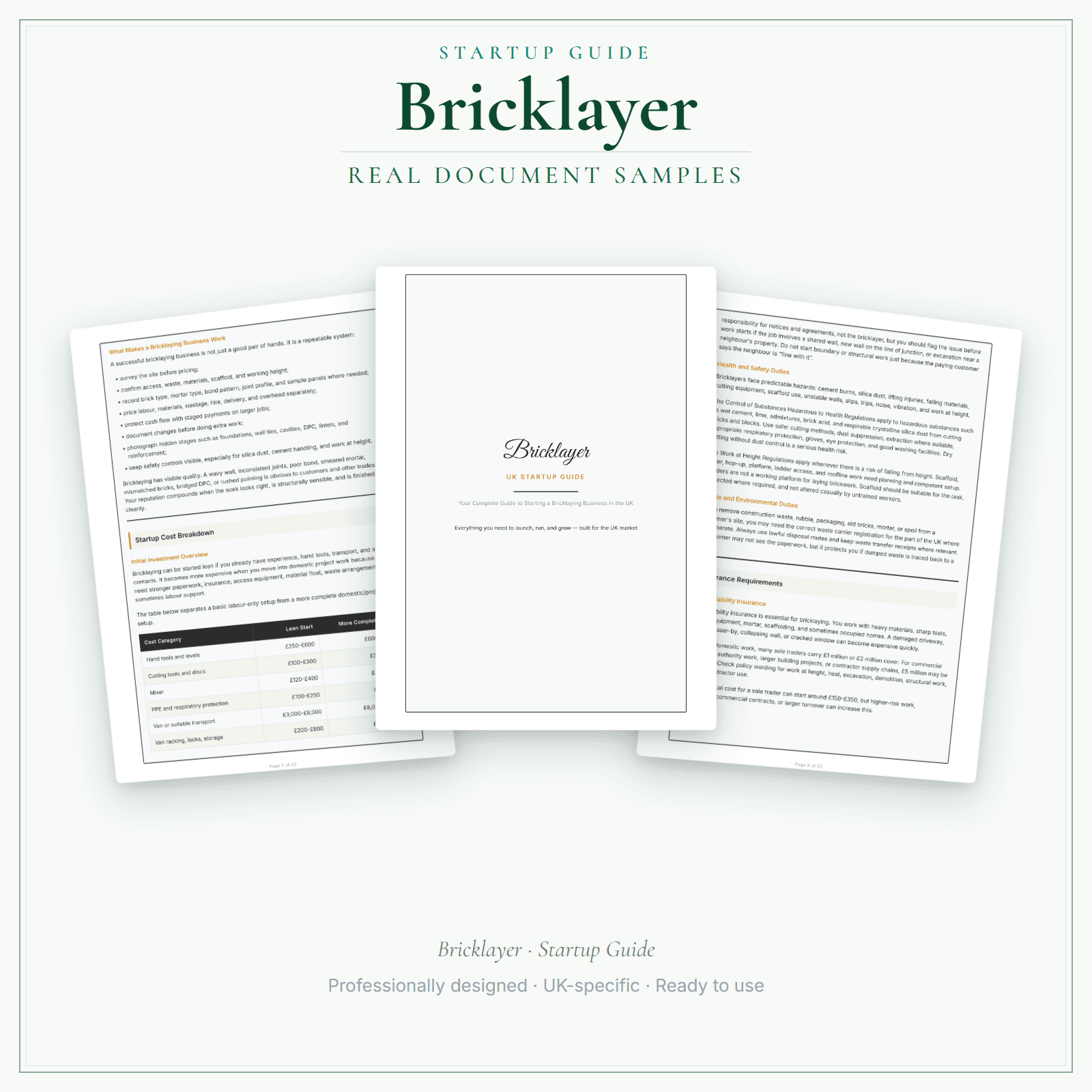
Pages from the Bricklayer Startup Guide.
Going self-employed as a bricklayer means more than turning up with a trowel — CSCS registration, CIS subcontractor setup, public liability insurance, builders' merchant accounts, and clear quotes for labour-only versus supply-and-fit work all need to be in place from the first job. This guide covers business registration, insurance for trade and site work, Building Regulations Parts A/B/C/L where they affect masonry, Party Wall Act considerations, lime mortar versus modern mixes for heritage work, and the first-90-days checklist.
Covers business registration, CSCS card routes, public liability insurance, CIS for subcontract work, and the choice between labour-only versus domestic project pricing
Includes a first-90-days checklist that addresses tools, builders' merchant accounts, and finding your first reliable contractor relationships
Addresses the real decisions: garden walls versus extensions versus heritage repointing, working with main contractors, and pricing per thousand bricks versus by the job
Preview pages
Preview what's inside
In the pack
What's included
- Business Overview
- Startup Cost Breakdown
- Regulatory Requirements
- Insurance Requirements
- Essential Equipment & Tools
- First 90 Days Launch Timeline
- Common Mistakes to Avoid
- Useful Links & Resources
- Marketing Your Business
- Financial Setup
- Finding Your First Customers
- Scaling & Growth
Preview pages
Made for the work
Put this product to work.
Use this read-and-print guide to organise the steps involved in starting your business. Work through its sections and check current requirements for your location and services.
Start with a task such as:
Identify costs and practical decisions to investigate.
Keep the guide alongside your own startup notes.
- Instant download
- Built in the UK
- One-time purchase
- Secure checkout
- Refund policy
- Support by email
Frequently Asked Questions
How do I receive Startup Guide?
After payment, look for your LaunchKit download email in the inbox you used at checkout. Open its link to your download page and download the files listed for your order. You'll receive a print-ready PDF, ready to read or print. Keep a copy of your downloaded files. If the email is missing or a link is not working, check your spam or junk folder, then contact hello@yourlaunchkit.co.uk with your checkout email address and order number, if you have it, for help recovering your files.
Can I edit these files?
PDF guide. Open on phone, tablet or desktop. Read or print. Not designed for editing.
Is this legal or tax advice?
No. LaunchKit templates are practical business resources. Review against your own circumstances and check suitability for your business.
Real reviews
What customers say
Swipe to read more customer reviews →
Free first
Setting up as a sole trader? Start with the free UK checklist.
The free UK sole trader setup checklist covers the generic first-90-day admin: HMRC registration, VAT, insurance, a business bank account, records and pricing. This startup guide then covers the operating decisions specific to your trade.
Open the free sole trader setup checklist →Useful next steps
Useful guides for your business.
How to Start a Bricklaying Business in the UK
Register with HMRC, sort insurance and CIS, get the CSCS card your sites need, quote with waste and access priced in, and put deposits and changes in writing on domestic jobs.
Read the guide →Building Regulations and scope of work for bricklayers: who is responsible for what
On most jobs a bricklayer's part is workmanship to the specification. How to agree who handles design, Building Control and CDM roles, and write it into your scope of works.
Read the guide →Essential business documents for UK bricklayers in 2026
A bricklayer running their own business needs a core set of documents that protect them at three distinct points: before work starts, while work is underway, and at sign-off. Most disputes can be…
Read the guide →Why LaunchKit
Built for the business you actually run.
Every bricklayer pack is checked so its page says exactly what format you get and what each tier includes. Templates are practical resources, not legal or tax advice — review against your own circumstances before use.
Complete your toolkit
More for Bricklayer
Business documents
Business Documents — Premium
17 business-record templates for Bricklayer businesses, each supplied as a fillable PDF and an editable DOCX file. Every template is also included in one fill-online HTML bundle: add your business details and brand colour in the sidebar of each template (they are saved per document, not shared between templates), then send clients a locked copy they can fill in with one click. Answers you haven't changed for 60 days are deleted the next time you open the form, and ‘Prepare copy for clients’ clears them; your business details and colour are kept. Type into the PDF fields or use a DOCX-compatible editor to change the business name, logo and wording. The exact delivered-file list is shown on this page. These practical templates do not provide legal, clinical or regulatory advice or certification, and do not replace any official records your work requires.
£19.99View →
Financial formsFinancial Forms Bundle — Premium
12 distinct financial record templates for Bricklayer businesses, each supplied as a fillable PDF and an editable DOCX file. Every template is also included in one fill-online HTML bundle: add your business details and brand colour in the sidebar of each template (they are saved per document, not shared between templates), then send clients a locked copy they can fill in with one click. Answers you haven't changed for 60 days are deleted the next time you open the form, and ‘Prepare copy for clients’ clears them; your business details and colour are kept. Type into the PDF fields or use a DOCX-compatible editor to change the business name, logo and wording. The delivered bundle includes a second invoice template under a legacy filename in both formats; it is not counted or advertised as a separate form type. These are templates, not automated spreadsheet software or accounting, tax or legal advice.
£19.99View →