Plan the setup tasks you still need to complete.
Electrician
Electrician Startup Guide
Digital downloadPrint-ready PDFInstant access
1 / 4
Real-world example
Look inside before you buy.
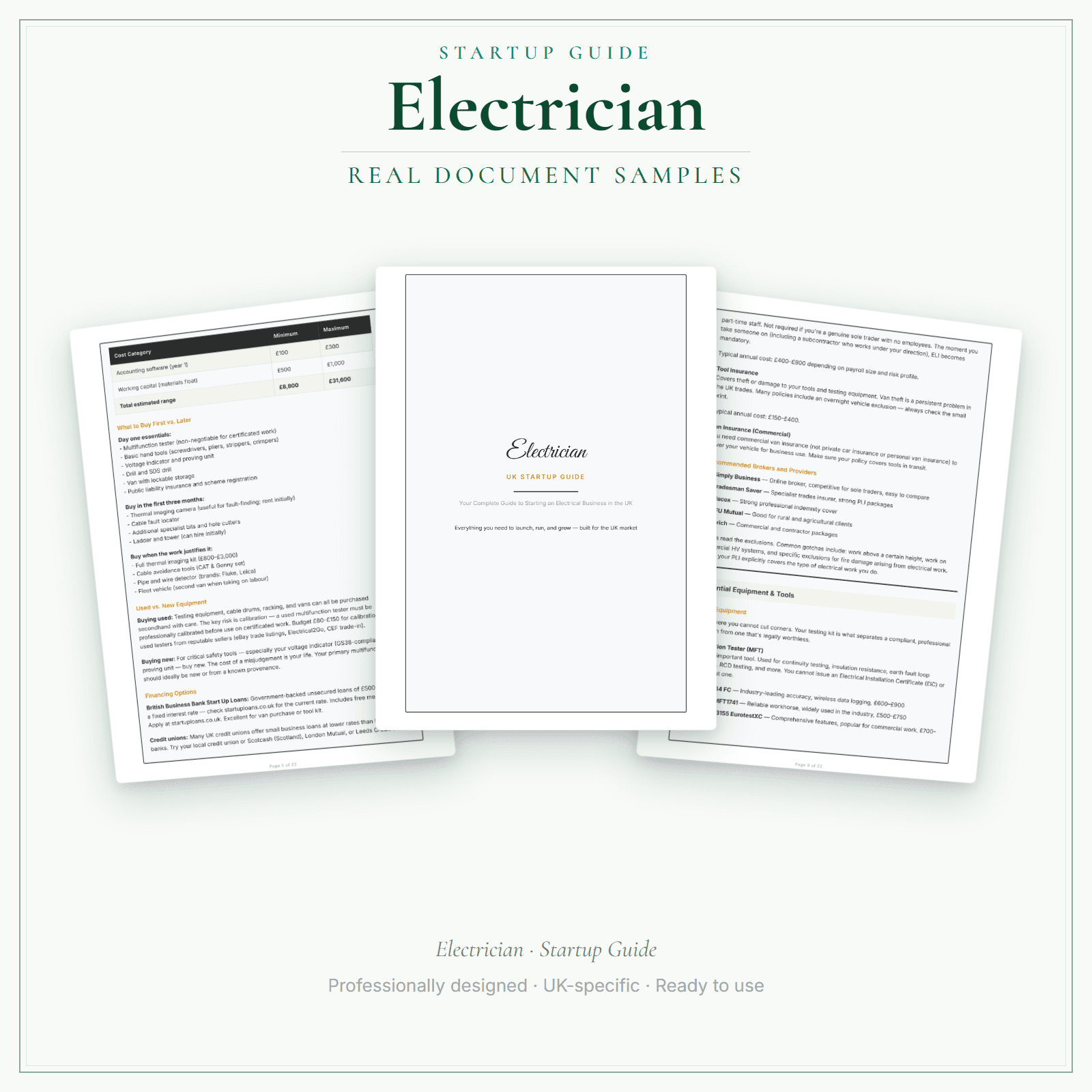
Pages from the Electrician Startup Guide.
Going self-employed as an electrician means defining the work you are competent to carry out, arranging suitable insurance and deciding how notifiable work will use either an authorised competent person scheme or Building Control. Scheme membership is voluntary; it is not a licence to trade. This guide covers business setup with HMRC, pricing, materials, subcontractors, electrical paperwork boundaries and a practical first-90-days checklist.
Explains competence, insurance, Part P boundaries, voluntary scheme options and the Building Control alternative
Includes a first-90-days checklist so you know exactly what to do — and in what order — before you take on your first customer
Written specifically for electricians, not generic small-business advice that ignores trade-specific requirements
Sample pages
Preview what's inside
In the pack
What's included
- Business Overview
- Startup Cost Breakdown
- Regulatory Requirements
- Insurance Requirements
- Essential Equipment & Tools
- First 90 Days Launch Timeline
- Common Mistakes to Avoid
- Useful Links & Resources
- Marketing Your Business
- Financial Setup
- Finding Your First Customers
- Scaling & Growth
Sample pages
Made for the work
Put this product to work.
Use this read-and-print guide to organise the steps involved in starting your business. Work through its sections and check current requirements for your location and services.
Start with a task such as:
Identify costs and practical decisions to investigate.
Keep the guide alongside your own startup notes.
- Instant download
- Built in the UK
- One-time purchase
- Secure checkout
- Refund policy
- Support by email
Frequently Asked Questions
How do I receive Startup Guide?
After payment, a confirmation email with your secure download links is sent to your checkout email within a few minutes. You'll receive a print-ready PDF, ready to read or print. If you don’t see the email, check your spam folder. Your download email is your permanent access — keep it. If you ever lose it, contact hello@yourlaunchkit.co.uk and we’ll re-send your files.
Can I edit these files?
PDF guide. Open on phone, tablet or desktop. Read or print. Not designed for editing.
Is this legal or tax advice?
No. LaunchKit templates are practical business resources. Review against your own circumstances and check suitability for your business.
Real reviews
What customers say
Swipe to read more customer reviews →
Free first
Setting up as a sole trader? Start with the free UK checklist.
The free UK sole trader setup checklist covers the generic first-90-day admin: HMRC registration, VAT, insurance, a business bank account, records and pricing. This startup guide then covers the operating decisions specific to your trade.
Open the free sole trader setup checklist →Useful next steps
Useful guides for your business.
How an EICR service line gives an electrician recurring landlord revenue
In England, private landlords must ensure the electrical installation is inspected and tested by a qualified and competent person at least every five years, or sooner when the previous report sets an…
Read the guide →Essential business documents every UK electrician should have ready
A self-employed UK electrician needs a small set of business-admin documents: a written agreement, quotation or estimate, invoice, risk record where appropriate, privacy information and clear…
Read the guide →Making Tax Digital for electricians: what's actually changing in April 2026
Making Tax Digital for Income Tax (MTD ITSA) hits self-employed electricians in three waves, based on qualifying income from self-employment and/or property: over £50,000 from 6 April 2026, over…
Read the guide →Why LaunchKit
Built for the business you actually run.
Every electrician pack is reviewed for accurate format and tier disclosure. Templates are practical resources, not legal or tax advice — review against your own circumstances before use.
Complete your toolkit
More for Electrician
Business documents
Business Documents — Premium
17 business-record templates for electrical businesses, each supplied as a fillable PDF and an editable DOCX file. Every template is also included in one fill-online HTML bundle: add your business details and brand colour once in the sidebar and they flow through every template, then send clients a locked copy they can fill in with one click. Type into the PDF fields or use a DOCX-compatible editor to change the business name, logo and wording. The exact delivered-file list is shown on this page.
£19.99View →
Financial formsFinancial Forms Bundle — Premium
14 distinct financial record templates for electrical businesses, each supplied as a fillable PDF and an editable DOCX file. Every template is also included in one fill-online HTML bundle: add your business details and brand colour once in the sidebar and they flow through every template, then send clients a locked copy they can fill in with one click. Type into the PDF fields or use a DOCX-compatible editor to change the business name, logo and wording. The delivered bundle includes a second invoice template under a legacy filename in both formats; it is not counted or advertised as a separate form type. These are templates, not automated spreadsheet software or accounting, tax or legal advice.
£19.99View →